
What if the sparkling stone on your finger is actually a three-billion-year-old time capsule from a world humans can never physically visit? You’ve likely felt the magnetic pull of their brilliance, yet the reality of their origin is often hidden behind technical jargon or the popular myth that they began as compressed coal. We’re taking you on a journey 150 kilometers below the Earth’s surface to discover exactly how are diamonds formed, stripping away the misconceptions to reveal a miraculous process of intense pressure, heat, and incredible longevity.
This guide will demystify the science of the deep mantle and explore the geological rarity that gives natural diamonds their enduring value, helping you distinguish between common legends and the breathtaking reality of Earth’s most coveted creation so you can celebrate your jewelry with both confidence and wonder.
Key Takeaways
- Uncover the “impossible” conditions of the Earth’s mantle that transform simple carbon into a symbol of eternal grace.
- Gain a scientific understanding of how are diamonds formed through intense heat and pressure equivalent to an elephant standing on your thumb.
- Trace the dramatic volcanic ascent that brings these billion-year-old treasures from the deep mantle to the surface.
- Debunk the common coal myth and learn why the immense age of natural diamonds makes them the ultimate legacy pieces.
- Understand how expert curation and certification protect the integrity of your jewelry’s miraculous geological journey.
The Genesis of Brilliance: A Miracle of Carbon and Time
Every diamond begins as the most humble of elements: carbon. While we often encounter carbon as the soft graphite in a pencil, the miracle of natural diamond formation occurs when this simple element is pushed to its absolute physical limits. To understand how are diamonds formed, we must look far beyond the surface. It requires a rare alignment of chemistry and physics that effectively turns the impossible into the eternal. These stones are far more than mere minerals; they are ancient messengers from the Earth’s infancy, carrying the secrets of a world that existed long before the first mountains rose or the first seas settled.
The Elemental Beginning: Why Carbon?
Carbon is the foundation of life, yet in a diamond, it achieves its most indestructible form. The secret lies in the way carbon atoms interact under extreme duress. While most substances have loose or layered atomic bonds, a diamond features unique tetrahedral bonding. Each carbon atom shares electrons with four others in a perfectly symmetrical, three dimensional web. This creates a structure so dense and stable that it resists any attempt at separation. This incredible structural integrity is what creates the hardest known natural substance on our planet. The diamond lattice is a masterpiece of atomic geometry. This rigid arrangement allows light to dance through the stone with unparalleled fire, creating the brilliance we celebrate in high quality jewelry today.
A Timeline Spanning Billions of Years
Time is the silent ingredient in every stone’s unique character. Most natural diamonds were forged between 1 and 3.5 billion years ago, a timeline that is almost impossible for the human mind to grasp. When you hold a diamond, you are touching something that was created when the Earth was still cooling and the first signs of life were barely emerging in the primordial oceans. These gems have survived volcanic eruptions, tectonic shifts, and the slow march of eons while remaining unchanged. This staggering age creates a profound sense of legacy. It connects your personal story to the very history of the planet.
While human history is measured in centuries, a diamond’s history is measured in eons. This natural rarity and the incredible journey from the deep earth define the essence of modern diamond collections. By understanding how are diamonds formed, we move from seeing a simple accessory to appreciating a piece of planetary history. Every sparkle is a reminder of a billion year wait for this exact moment of discovery.
The Deep Earth Forge: Heat, Pressure, and the Mantle
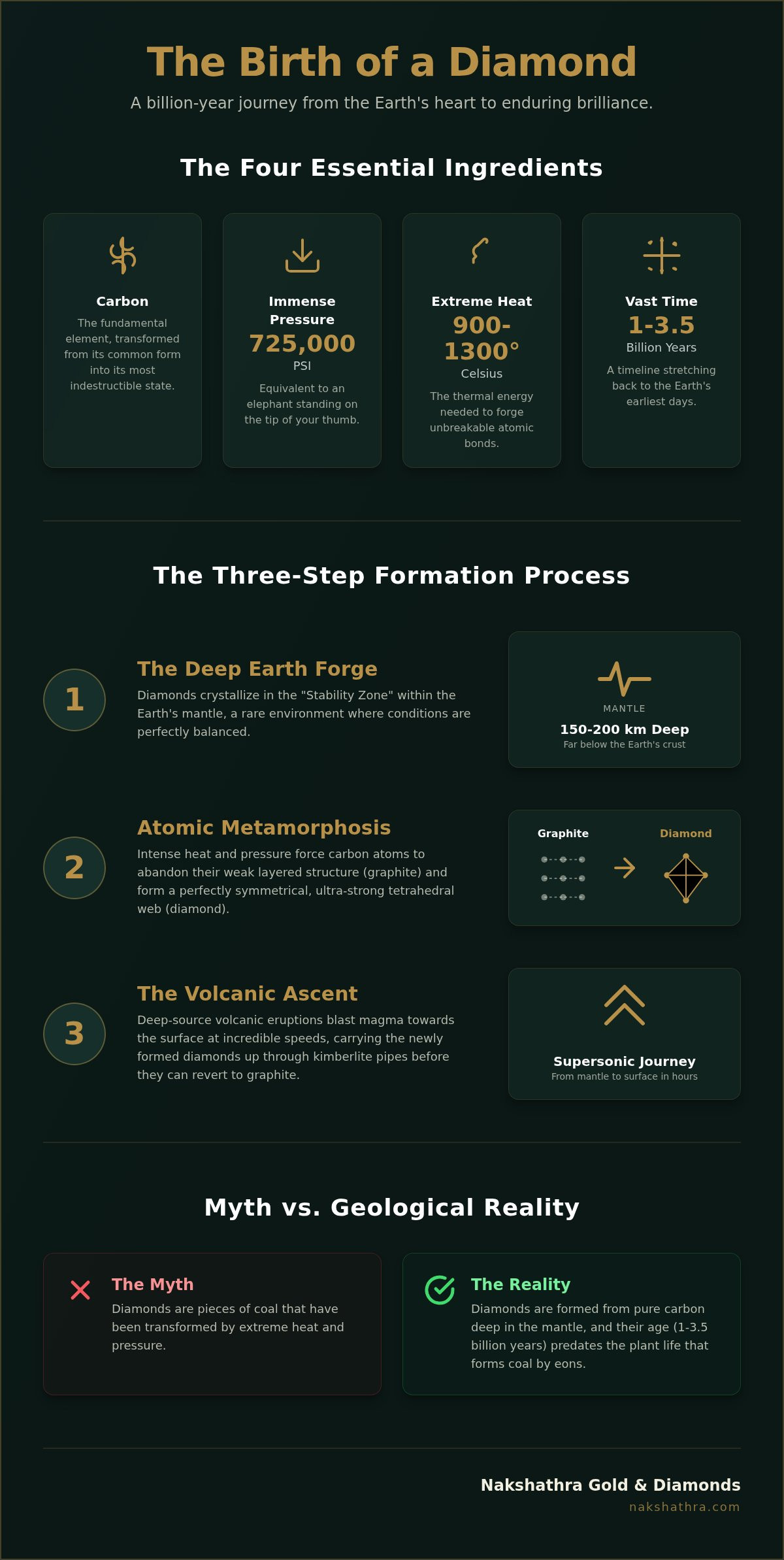
Visualize a place 150 to 200 kilometers below the soil, far beneath the crust where we build our cities and lives. This specific region of the Earth’s mantle serves as a high pressure laboratory, a world where the laws of the surface simply don’t apply. To truly grasp how are diamonds formed, one must imagine a weight so immense it crushes the very essence of matter into something entirely new. The pressure here is staggering, reaching roughly 725,000 pounds per square inch. To put that into perspective, it’s equivalent to an adult elephant balancing all its weight on the tip of your thumb. It’s an environment of pure, unyielding force.
This region is often referred to as the “Stability Zone.” It’s a rare geological pocket where the temperature and pressure are perfectly balanced to keep carbon in its crystal diamond state. If the pressure drops even slightly, or the temperature shifts, the carbon would remain as graphite. Understanding how are diamonds formed also requires looking at the movement of the Earth itself. Tectonic plate movements play a vital supporting role, acting as a geological conveyor belt that drags carbon rich rocks from the surface deep into these high pressure zones, setting the stage for a transformation that takes millions of years to complete.
Under Pressure: The Physics of Hardness
At 725,000 pounds per square inch, carbon atoms are forced into a state of incredible proximity. They have no choice but to bond with a strength that is unmatched in the natural world. This unyielding pressure is what ensures the stone’s legendary longevity and its eternal nature. It’s a beautiful metaphor for life; perfection often requires immense resilience. Just as a diamond ring represents a lifetime of enduring commitment, the stone itself is a product of surviving the unthinkable. This tight atomic bonding is what allows a diamond to scratch any other material while remaining unscathed itself.
The Role of Extreme Heat
Heat is the second pillar of this deep earth forge. Temperatures in these diamond forming regions typically range from 900°C to 1300°C. This intense thermal energy provides the necessary power for carbon atoms to break their existing bonds and reform into a rigid crystal lattice. However, the balance is incredibly delicate. If the temperature climbs too high, the diamond won’t just fail to form; it will actually dissolve back into the surrounding mantle. Nature must maintain this precise equilibrium for eons to produce a single gem quality stone. When you appreciate the complexity of this process, you realize that every natural stone is a small miracle of physics. If you’re looking for a piece that captures this sense of rare beauty, you might find inspiration in our Bridal Jewellery Collection.
The Volcanic Ascent: How Diamonds Reach the Surface
After spending eons in the deep mantle, a diamond’s journey to the surface is anything but gradual. It is a violent, high-speed escape. While we’ve explored how are diamonds formed in the quiet intensity of the stability zone, their arrival at the Earth’s crust requires a geological event of immense power. These events are deep-source volcanic eruptions, fueled by magma that originates much deeper than the typical volcanoes we see on the news. This magma acts as a courier, picking up stones from the mantle and racing toward the surface before the carbon has a chance to change its state.
The Kimberlite Pipe: Nature’s Delivery System
Kimberlite and Lamproite act as the high-speed elevators of the mineral world. This specialized, gas-rich magma traps diamonds in its path and carries them upward at speeds that some researchers believe can reach supersonic levels. Speed is the critical factor for survival. If the ascent were slow, the decreasing pressure would cause the carbon atoms to reorganize back into graphite. To remain a gemstone, the diamond must experience rapid cooling as it nears the surface, effectively freezing its crystal structure in place forever.
As the magma erupts, it carves out carrot-shaped veins known as Kimberlite pipes. These vertical structures become the primary locations where diamonds are discovered and mined. It’s a humbling reality that not all pipes contain diamonds; in fact, many are completely empty of gems. This geological hit-or-miss is a primary reason why natural diamonds command such high value. The rarity isn’t just in the question of how are diamonds formed, but in the slim chance they survive the chaotic journey and are delivered to a reachable depth.
From Deep Mantle to Modern Discovery
Once the eruption settles, the diamonds are locked within the hardened kimberlite rock, waiting for the next chapter of their story. Over millions of years, the relentless forces of wind and water begin to erode the surface. This natural wear eventually reveals the pipes to human discovery. In some cases, the diamonds are washed away entirely, traveling miles through riverbeds to become alluvial deposits, where they’re eventually found polished by the water’s flow.
This long, arduous path from the Earth’s heart to a riverbed or a mine is what makes every stone a unique artifact of time. Whether it eventually finds its home in a sophisticated pear diamond ring or a classic bridal set, its brilliance is a celebration of resilience. Every facet reflects a journey that began 150 kilometers below us, proving that true elegance is often forged in the most extreme conditions.
Debunking the Coal Myth and Understanding Natural Variations
One of the most persistent legends in the world of gemstones is the idea that diamonds began their lives as lumps of coal. It’s a poetic thought, the idea of a dirty fuel transforming into a brilliant treasure, but the geological reality is far more fascinating. When we look at how are diamonds formed, we find that they have almost nothing in order with coal. This myth persists because both are made of carbon, yet they exist in entirely different worlds. Coal is found near the Earth’s surface in sedimentary rocks, while diamonds are forged in the fiery depths of the mantle, hundreds of kilometers below where any coal could ever exist.
The Coal vs. Carbon Debate
The strongest proof against the coal myth lies in the timeline of our planet. Most natural diamonds are between 1 and 3.5 billion years old. In contrast, the first land plants, which are the biological source of coal, didn’t even appear until about 450 million years ago. This means that the majority of the world’s diamonds were already ancient before the first leaf ever sprouted on Earth. Diamonds are older than life itself. While coal is an organic material made from decaying vegetation, diamonds are primarily inorganic carbon that has been part of the Earth since its very foundation. They are not recycled plants; they are the original building blocks of our world, crystallized into a form of permanent grace.
Nature’s Fingerprints: Inclusions and Color
If diamonds were perfectly pure carbon, they would all be completely colorless. However, the deep earth is a complex place, and during the billion year process of crystallization, other elements sometimes join the party. These “impurities” are actually what give certain stones their rare and sought after personalities. For instance, the presence of nitrogen atoms creates warm yellow tints, while trace amounts of boron result in the rare and regal blue hues found in some of the world’s most famous gems. These variations are the Earth’s own artistic flourishes, ensuring that no two stones are ever truly identical.
Beyond color, most natural diamonds contain “inclusions,” which are tiny crystals of other minerals trapped inside the diamond lattice as it grew. Rather than seeing these as flaws, gemologists view them as birthmarks that prove a stone’s natural origin. They are microscopic time capsules from the mantle. These unique internal features often influence how a stone is cut to maximize its beauty. The elongated facets of an oval diamond, for example, are often chosen to highlight a stone’s specific clarity and brilliance. Understanding how are diamonds formed with these natural variations helps us appreciate that perfection isn’t about being “flawless” in a sterile sense, but about the unique story each stone tells.
If you are ready to find a stone that carries its own piece of Earth’s history, we invite you to explore our Diamond Collections and discover the natural masterpiece that speaks to your journey.
From Earth’s Heart to Your Collection: The Nakshathra Standard
Every sparkling stone in our care has survived an odyssey that began billions of years ago. At Nakshathra, we see ourselves as more than just jewelers. We are visionary guides who curate the finest results of the Earth’s ancient labor. Having explored how are diamonds formed in the deep mantle, it becomes clear that selecting a diamond is about more than just aesthetics; it is about honoring a geological miracle. We believe that this level of brilliance and quality should be part of your everyday experience. Our democratizing spirit ensures that elegance is attainable, whether you are choosing a piece from our grand Bridal Jewellery Collection or seeking the subtle, sophisticated grace of lightweight gold for daily wear.
The Art of Expert Curation
Our specialists approach each stone with the quiet authority of experts who value both craftsmanship and clarity. We evaluate the 4Cs, cut, color, clarity, and carat weight, not just as technical metrics but as a way to respect the stone’s unique origin. Transparency is at the heart of our philosophy, and we are committed to ethical integrity in every piece we offer. Every stone in our curated Diamond Collections comes with certification to verify its natural journey from the deep earth to the light of day. For those who seek a shape that mirrors the regal nature of this geological formation, the marquise diamond offers a unique, historic silhouette that captures the light with unparalleled fire and grace.
A Legacy You Can Wear
Owning a natural diamond means wearing a piece of eternity. It is a validation of your own personal journey, a stone that has endured extreme pressure to emerge as something beautiful and permanent. We treat every milestone, whether a major life event or a quiet daily achievement, with equal reverence. We encourage you to visit our showroom for a tactile experience of these natural wonders. Seeing these stones in person allows you to appreciate the depth of how are diamonds formed in a way that words cannot fully capture. You can feel the weight of history and the pulse of the Earth in every facet. Our team is here to provide friendly, approachable guidance as you select a legacy piece that reflects your own resilience and success. Discover the brilliance forged by time in our latest collections today.
Begin Your Own Eternal Story
A diamond is far more than a beautiful accessory. It’s a testament to the Earth’s incredible power and patience. Understanding how are diamonds formed reveals a billion-year journey of survival through impossible heat and pressure. These stones are ancient messengers that have traveled from the deep mantle to become symbols of your most cherished milestones.
At Nakshathra, we honor this miraculous history by selecting only exceptional GIA and IGI certified diamonds. Our specialists in modern lightweight designs and bridal sets are ready to welcome you across our 25 plus showrooms globally. You deserve a stone that’s as resilient and brilliant as your own journey. We’re committed to transparency and ethics, ensuring that your jewelry is as clear in its origin as it is in its beauty.
Explore the Brilliance of Our Curated Diamond Collections
Every sparkle is a celebration of a journey that began long before us. We’re here to help you find the piece that carries the legacy of the deep earth into your bright future. Let your story shine with a brilliance that has stood the test of time.
Frequently Asked Questions
Are diamonds really made from coal?
No, diamonds are not made from coal. They crystallize from carbon trapped deep within the Earth’s mantle, whereas coal is formed from decaying plant matter much closer to the surface. Most natural diamonds were forged billions of years before the first land plants even existed. This makes them inorganic treasures of our planet’s infancy rather than pressurized fossils.
How deep in the Earth are diamonds actually formed?
Most diamonds are created at depths between 150 and 200 kilometers below the Earth’s surface. This specific region in the mantle provides the intense pressure and heat necessary for carbon to transform into a crystal lattice. Scientists call this the “diamond stability zone.” It is a rare geological pocket where conditions are exactly right to keep the stone’s structure intact.
How long does it take for a diamond to form naturally?
The natural crystallization process can take millions of years to complete. However, the stones then wait in the Earth’s mantle for billions of years before a volcanic event brings them to the surface. When you ask how are diamonds formed, it’s important to realize it’s a slow, patient miracle of time. They aren’t just minerals; they are ancient artifacts of our planet’s history.
Why do diamonds come to the surface through volcanoes?
Diamonds reach the surface through rare, deep-source volcanic eruptions known as Kimberlite or Lamproite events. These eruptions act like high-speed elevators, carrying the gems from the mantle to the crust in a matter of hours. This rapid ascent is vital. It cools the stones quickly, which prevents the carbon from reorganizing into graphite during the sudden drop in pressure.
What is the difference between natural and lab-grown diamond formation?
Natural diamonds are forged by the Earth’s geological forces over billions of years, while lab-grown diamonds are created in controlled environments over several weeks. Both share the same physical and chemical properties. However, the story of how are diamonds formed in nature involves a unique legacy of time and rarity that can’t be replicated. This natural journey is what gives each mined stone its enduring value.
What makes a diamond the hardest natural substance on Earth?
A diamond’s legendary hardness comes from its unique atomic structure. Each carbon atom is bonded to four other carbon atoms in a perfect, three-dimensional tetrahedral lattice. This arrangement is incredibly rigid and stable. It’s this specific geometric “diamond lattice” that allows the stone to resist scratching and wear better than any other material found in the natural world.
Can diamonds be found in every country?
No, diamonds are only found in specific regions with very old, stable parts of the Earth’s crust called cratons. These areas must also have experienced the right type of volcanic activity to bring the stones to reachable depths. Major deposits are concentrated in countries like Russia, Botswana, Canada, and Angola. This geographical exclusivity is another reason why natural diamonds remain so highly prized.
How old is the average diamond found in jewelry today?
The average diamond you see in jewelry today is between 1 and 3.5 billion years old. To put that in perspective, the Earth itself is roughly 4.5 billion years old. When you wear a diamond, you’re wearing a piece of the planet that has existed for nearly two-thirds of its entire history. It’s a tangible connection to the deep past that remains brilliant today.
Comments are closed